How to Use GA4 Predictive Metrics for Smarter PPC Targeting
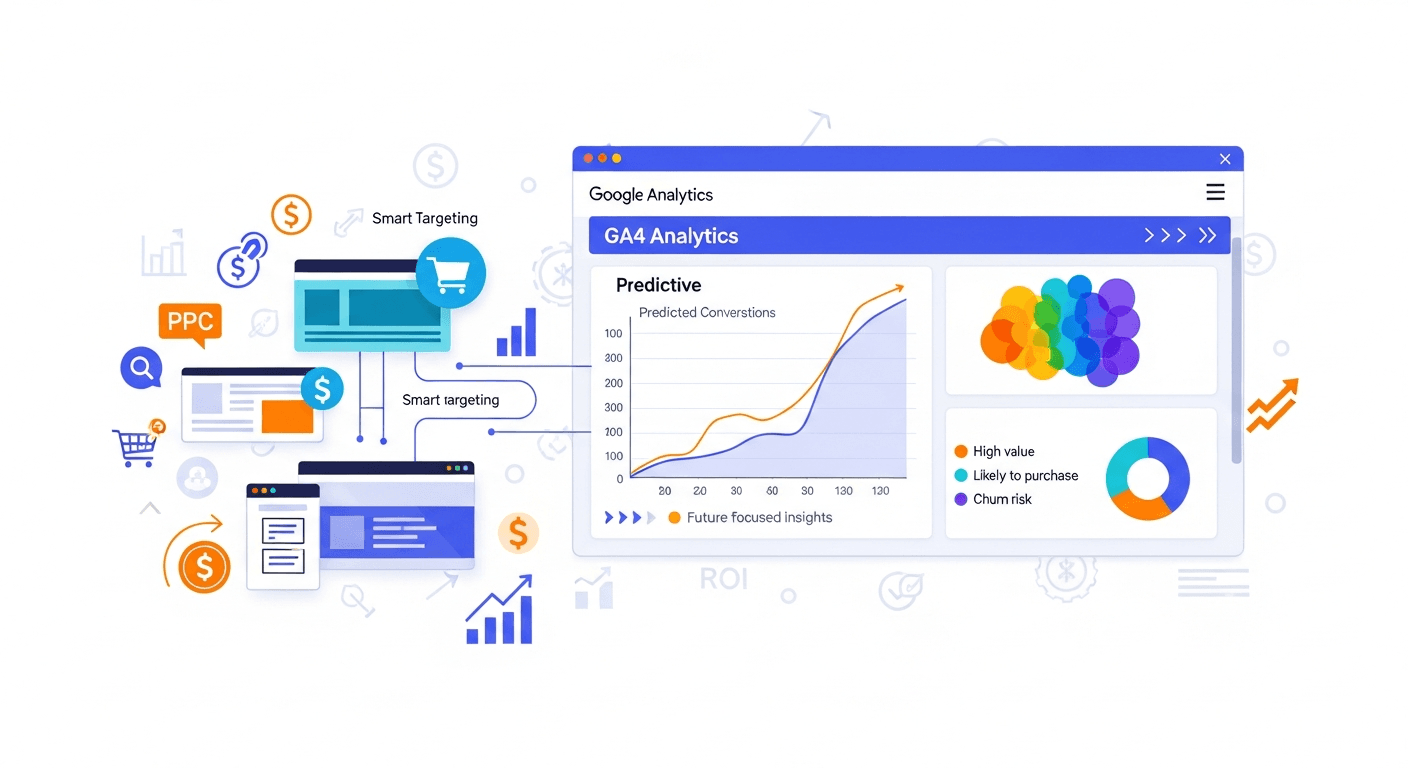
Google Analytics 4 predictive metrics give advertisers a powerful way to connect first party behavioral data with paid media targeting. When configured correctly, GA4 predictive audiences can send high intent signals into Google Ads, improve bidding efficiency, and support privacy ready performance strategies. This article explains, in practical terms, how to operationalize these capabilities for smarter PPC targeting.
Why GA4 Predictive Metrics Matter for PPC Right Now
Google Analytics 4 predictive metrics use machine learning to estimate the likelihood that a user will complete a future action or churn. For PPC programs, these signals can become high quality targeting and bidding inputs, especially as third party cookies phase out and conversion tracking becomes less complete. In practice, GA4 predictive metrics do not replace conversion data or incrementality testing. Instead, they provide an additional, privacy aware layer that influences which users are prioritized in campaigns. GA4 does not directly change bids in Google Ads, but predictive audiences exported from GA4 can guide Smart Bidding toward users with stronger modeled intent.
Core GA4 Predictive Metrics Relevant to PPC
GA4 currently offers a small set of official predictive metrics. Only some of them are directly useful for PPC targeting, and each has strict eligibility conditions.
What is purchase probability in GA4?
Purchase probability in GA4 is a predictive metric that estimates the likelihood a user will complete a purchase event in the next 7 days, based on their past behavior on a specific GA4 property. The metric is available only when event volume and data quality thresholds are met and is limited to users observed on that property, not cross property behavior.
What is predicted revenue in GA4?
Predicted revenue in GA4 is a metric that estimates the revenue a user is likely to generate from purchase events in the next 28 days. It is calculated from historical event and value patterns on the same GA4 property and is available only after Google’s modeling thresholds are met, so it may be missing for smaller sites or low volume segments.
What is churn probability in GA4?
Churn probability in GA4 measures the likelihood that a recently active user will not return in the next 7 days. It is primarily designed for retention and re engagement use cases and is available only for properties with sufficient recurring activity, so very low traffic or one time purchase sites may not receive valid churn predictions.
Eligibility Requirements and Practical Constraints
Not every GA4 property qualifies for predictive metrics. Google applies strict thresholds to protect user privacy and ensure that prediction models are statistically reliable.
Sufficient conversion events for the chosen predictive metric
Consistent event tracking and value parameters
Compliance with Google data policies and consent settings
Property level modeling quality thresholds
As a result, some advertisers will not see predictive metrics in the GA4 interface. In these cases, GA4 PPC strategies must rely on conventional remarketing lists, custom segments, and conversion based bidding alone.
How does GA4 decide when to show predictive metrics?
GA4 decides to show predictive metrics when a property meets internal minimum thresholds for event volume, purchase or churn frequency, and data stability over time. These thresholds are enforced automatically and are not configurable, which means advertisers cannot manually override them and must instead improve tracking coverage and traffic quality to qualify.
Mapping GA4 Predictive Metrics to PPC Use Cases
Once predictive metrics are available, the next step is to map them to specific PPC tactics. Different business models and account structures will determine where GA4 can add the most value.
When should you use purchase probability for PPC targeting?
Purchase probability works best when there is a clear purchase event, relatively short decision cycles, and enough transactions to sustain modeling. It is less effective if purchases are rare, high value, or heavily influenced by offline steps, because the prediction only considers behavior captured in GA4 and cannot see external sales processes.
When should you use predicted revenue for PPC bidding?
Predicted revenue is suitable when the primary goal is to maximize revenue within a constrained budget and when purchase values vary significantly between users. It is less useful when all conversions have similar value or when offline revenue dominates, since GA4 predictions only include revenue passed through e commerce events on the configured property.
When should you use churn probability for remarketing campaigns?
Churn probability is best used for remarketing when there is ongoing engagement such as subscriptions, apps, or repeat purchases, and when preventing churn has measurable value. It is not recommended for single purchase products or campaigns focused solely on first time acquisition, because the metric reflects future inactivity rather than initial conversion intent.
Setting Up GA4 Predictive Audiences for Google Ads
For predictive metrics to influence PPC performance, audiences must be built in GA4 and linked to Google Ads. GA4 creates predictions at the user level, and audiences wrap these predictions into usable segments.
How to create a purchase probability audience in GA4
In GA4, navigate to Configure then Audiences.
Click New audience and choose a predictive template such as Likely 7 day purchasers, if available.
Adjust the prediction threshold, for example, purchase probability greater than 0.7, to define high intent.
Apply filters such as geography or device if needed, noting that extra filters can reduce list size.
Save the audience and allow time for GA4 to populate users.
How does GA4 predictive audience size affect PPC performance?
GA4 predictive audience size affects PPC performance by determining delivery scale and learning speed for bidding algorithms. Very small audiences can improve efficiency per click but limit impression volume, while very broad thresholds may dilute intent. Advertisers must balance predictive probability cut offs with minimum list sizes required for Google Ads to exit the learning phase.
Linking GA4 predictive audiences to Google Ads
After audiences are defined, they must be shared with Google Ads.
In GA4, go to Admin then Product links and confirm a Google Ads link is active and set to share personalized advertising signals.
Ensure the option to enable ads personalization for the linked accounts is turned on.
In Google Ads, navigate to Tools and settings then Audience manager to confirm the GA4 predictive audiences appear.
Assign these audiences to relevant campaigns or ad groups as observation or targeting lists.
Audience availability can be delayed by up to 24 hours, and Google Ads may apply additional minimum size requirements before lists can be used for some strategies.
Targeting Strategies Using GA4 Predictive Metrics
There are several distinct ways to use GA4 predictive metrics within Google Ads campaigns. Each strategy has different trade offs and depends on current performance baselines.
How does GA4 predictive targeting work with Smart Bidding?
GA4 predictive targeting works with Smart Bidding by supplying higher intent audience signals that Google Ads can factor into bid calculations. The system still optimizes primarily to conversions or conversion value, so predictive segments serve as modifiers rather than goals. Performance gains depend on accurate tagging, stable conversion tracking, and sufficient data volume for Smart Bidding to model effectively.
Strategy 1: High purchase probability audiences for efficiency
This approach focuses budget on users with a high predicted likelihood to purchase.
Create a GA4 audience for users with purchase probability above a defined threshold.
Import it into Google Ads and apply as a targeting list on Search and Performance Max campaigns.
Set a target ROAS or target CPA that is slightly more aggressive than the account average.
This strategy works best when there is already a reasonable conversion volume and the objective is to reduce wasted spend rather than scale aggressively. It is less suitable for new accounts with little history.
Strategy 2: Predicted revenue segments for value based optimization
Predicted revenue supports more nuanced value based bidding than binary conversions.
Define GA4 audiences for users falling into predefined predicted revenue bands.
In Google Ads, apply high predicted revenue audiences with higher bid targets or distinct campaigns.
Align value based bidding strategies such as target ROAS to prioritize these segments.
This approach is most effective when actual revenue reporting in GA4 is accurate and when Google Ads conversion values reflect meaningful business value, not just order totals with unaccounted returns.
Strategy 3: Churn probability for re engagement PPC
Churn probability can drive efficient retention campaigns.
Build GA4 audiences of likely churning users based on churn probability thresholds.
Serve re engagement messages, win back offers, or subscription renewal reminders through Search, Display, or YouTube.
Measure incremental uplift by comparing exposed vs unexposed similar cohorts, where possible.
This works best for subscription and app businesses with measurable lifetime value. For businesses with low repeat purchase behavior, churn based audiences may be too small or economically insignificant.
Limitations, Privacy Considerations, and Data Gaps
GA4 predictive metrics operate within Google’s privacy framework, which means there are structural limitations that advertisers must understand before relying heavily on these signals.
Does GA4 predictive modeling replace first party CRM data?
GA4 predictive modeling does not replace first party CRM data, because it uses on site and in app behavioral signals rather than full customer histories, pricing plans, or offline interactions. It can complement CRM by identifying intent patterns before contact details are captured, but it cannot access or process external databases directly without additional integrations.
What visibility does GA4 provide into its predictive models?
GA4 provides only high level visibility into predictive models, exposing outputs like probabilities and revenue bands but not the underlying feature weights or algorithms. Users can see segment sizes and trends, yet cannot audit model internals or adjust training logic, so any bias or inaccuracy must be managed indirectly through better tagging, data governance, and ongoing validation.
Key constraints to remember
Predictions are property specific and do not automatically combine web, app, and offline data unless those streams are correctly unified.
Consent mode, ad personalization settings, and regional regulations can limit eligibility for predictive features.
Model accuracy can drift as user behavior, pricing, or product mix change, which requires periodic re evaluation.
Attribution windows in Google Ads and GA4 may differ, complicating direct performance comparisons.
Measurement, Attribution, and Incrementality
Predictive metrics improve targeting, but measurement discipline is still required to prove incremental value. Attribution reports show correlations, while incrementality tests estimate what would have happened without the tactic.
How should you measure the impact of GA4 predictive audiences in PPC?
The impact of GA4 predictive audiences should be measured using structured A and B experiments that compare campaigns or ad groups with and without predictive audiences, while holding other settings constant. Single account reporting views are insufficient, because external factors and seasonality can distort results, so controlled tests and, where possible, geo based experiments are recommended.
When should you avoid relying solely on GA4 predictive metrics?
Reliance solely on GA4 predictive metrics should be avoided when overall conversion volume is low, tracking is incomplete, or offline revenue dominates business outcomes. In these environments, model estimates can be noisy, and over weighting them may degrade bidding decisions, so predictive signals should remain secondary to verified conversions and robust incrementality experiments.
Implementation Checklist and Next Steps
A structured implementation plan helps ensure that GA4 predictive metrics improve PPC programs instead of adding noise.
Operational implementation steps
Validate tracking Confirm GA4 purchase events, values, and user identifiers are firing consistently. Fix missing parameters, duplicate events, and attribution inconsistencies.
Check eligibility Review the GA4 Predictive section for purchase probability, predicted revenue, and churn probability. If unavailable, prioritize increasing traffic and improving event coverage.
Build audiences Create high intent, medium intent, and churn risk audiences based on predictive thresholds, and document their definitions clearly for internal stakeholders.
Link to Google Ads Verify GA4 to Google Ads linking and personalized advertising settings. Confirm audiences appear in Audience manager and reach minimum list sizes.
Launch structured tests Roll out predictive audiences in a limited number of campaigns first, with experimental setups to compare against existing strategies.
Review and recalibrate Monitor performance at least monthly, adjusting thresholds and audience logic as product lines, pricing, and user behavior evolve.
What to do next if predictive metrics are not available yet
Improve conversion tracking completeness, including adding value parameters and standardizing event naming.
Focus budget on campaigns with strong, clearly measurable conversions to build the necessary event history.
Use non predictive GA4 audiences based on recency, frequency, and value bands as an interim solution.
Document current baselines so any future uplift from predictive metrics can be evaluated properly.
GA4 predictive metrics for PPC, summarized:
GA4 predictive metrics such as purchase probability, predicted revenue, and churn probability can create high intent audiences that influence Google Ads targeting and bidding.
These metrics are available only when GA4 properties meet strict volume, data quality, and privacy thresholds, which many smaller sites do not initially satisfy.
Reporting exposes prediction outputs and audience performance but does not reveal internal model logic, and attribution windows may differ between GA4 and Google Ads.
Effective use requires accurate event tracking, clear audience definitions, structured experiments, and a willingness to prioritize verified conversions over purely modeled signals.